Premier League: What We’ve Learned About Goal Contribution After the First Half of the Season

What We’ve Learned About Goal Contribution After the First Half of the Season
Nineteen matchdays.
More than 500 goals analysed.
The first half of the Premier League 2025–26 is now complete, and with it comes a perfect checkpoint to reassess attacking performance — not just through the traditional Goals + Assists (GA) lens, but through Goal Contribution (gC).
This article takes a step back and answers a simple question:
What does gC tell us about attacking hierarchy that GA alone cannot?
1. GA and gC: Same Story, Different Language?
Let’s start with the obvious:
GA and gC are strongly related, but they are not equivalent.
When comparing player rankings based on GA and gC across the league, we observe a high Spearman rank correlation, 0.606, confirming that elite attackers tend to remain elite regardless of the metric.
This correlation reassures us:
👉 gC is not an arbitrary metric.
👉 It aligns with football reality.
But correlation is only the beginning of the story.
2. A Different Hierarchy Emerges
When ranking players purely by Goal Contribution, the attacking hierarchy subtly — but meaningfully — changes.
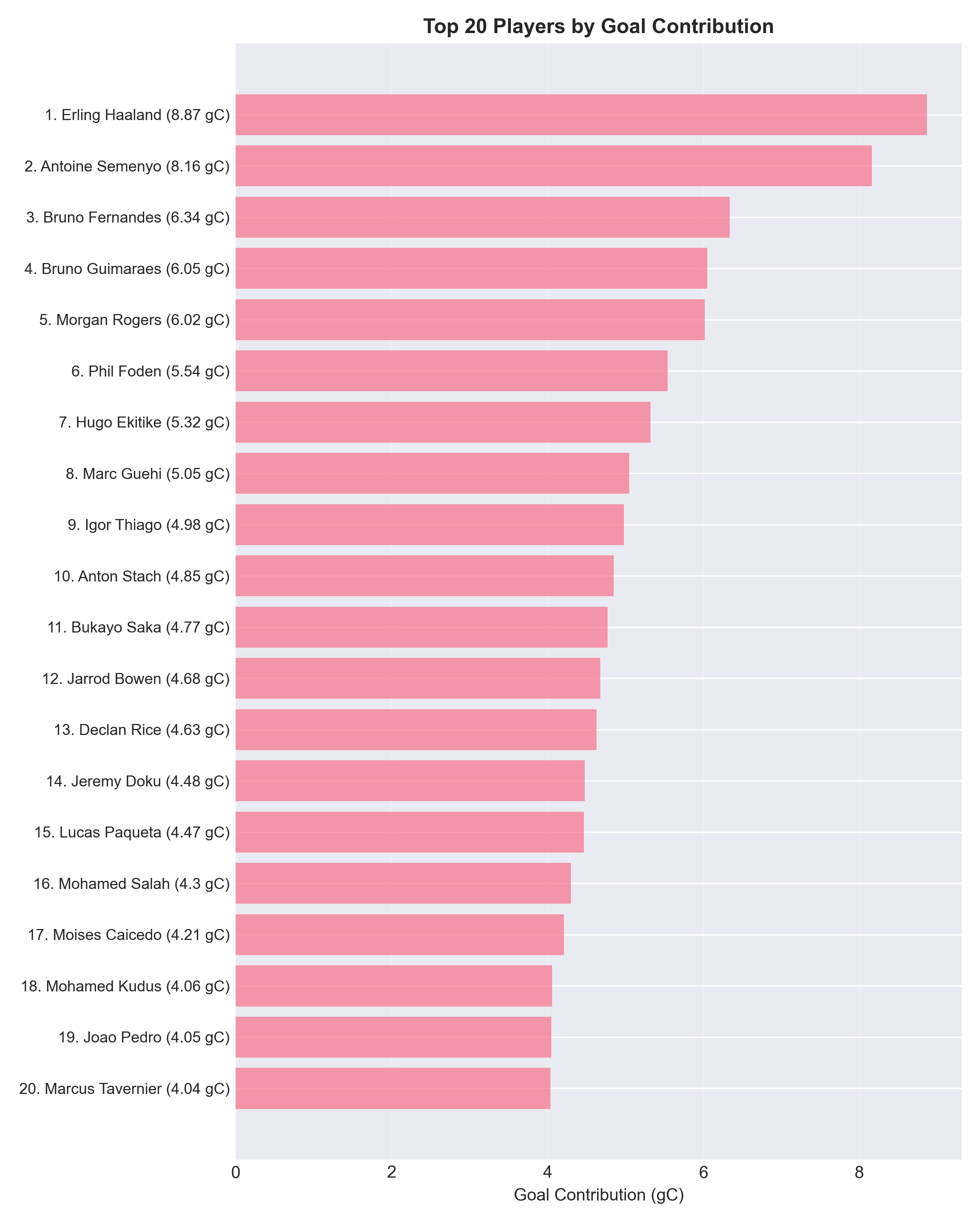
Compared to the traditional Top 20 by GA, several players:
- climb significantly in the rankings,
- while others lose ground despite strong raw goal and assist totals.

This divergence is where gC starts to show its real value.
3. The Rank Gap: Who GA Underrates (and Overrates)
To quantify these differences, we compare rank positions directly.
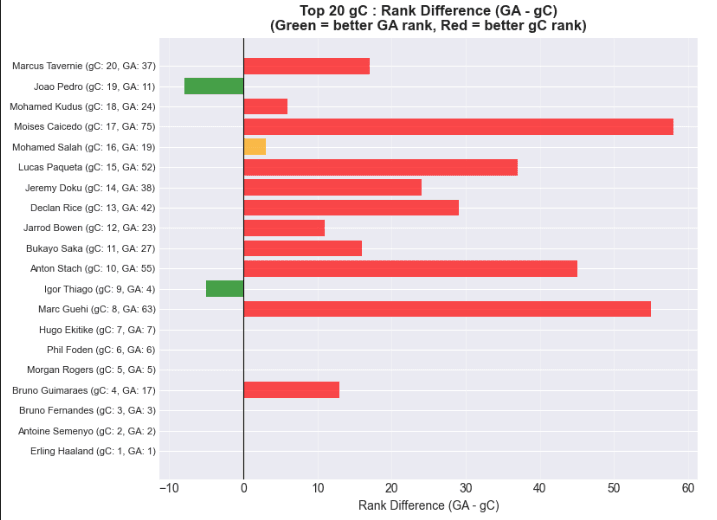
- Positive gap (red bars): players ranked significantly higher by gC than GA
- Negative gap (green bars): players favoured significantly by GA
This highlights a crucial insight:
GA rewards outcomes. gC rewards involvement.
Some attackers generate value consistently before the final pass or shot — and GA simply doesn’t see it. Across all 376 analyzed players, the average rank gap between GA and gC is 16.35, with a standard deviation of 18.95. This highlights how decisively impactful players can be heavily undervalued by GA, dropping far down the rankings despite genuine involvement in goal-scoring actions — involvement that is clearly captured by gC. Several of these profiles, from the first half of the Premier League season, are highlighted in the next section.
4. Same Top 20… But Not the Same Players
Despite a decent overlap between the two Top 20 lists, the match is far from perfect with a ratio of only 50% (10 common players in the two lists).
Key takeaways:
- The overlap ratio confirms structural similarity
- But several high-gC players are completely absent from the GA Top 20
- These profiles are often:
- connective attackers and midfielders,
- high-involvement defenders
In other words:
players who make attacks work, not just finish them. Their list includes Lucas Paqueta (AM, West Ham United), Anton Stach (CM, Leeds United), Declan Rice (LM, Arsenal FC), Marc Guehi (CB, Crystal Palace FC), Moises Caicedo (CM, Chelsea FC), Jeremy Doku (LW, Manchester City FC), Marcus Tavernier (CM, Bournemouth AFC), Mohamed Kudus (RW, Tottenham Hotspur FC), Bukayo Saka (RW, Arsenal FC) and Jarrod Bowen (RW, West Ham United).
5. Why gC Is a Better Performance Signal Than GA
GA treats all contributions equally:
- a tap-in goal,
- a 40-meter carry,
- a decisive pre-assist
gC does not.
By weighting how much a player contributes to a goal sequence, gC:
- captures repeatable influence,
- reduces noise from isolated finishing streaks,
- and highlights players who consistently raise their team’s scoring probability.
This is why gC often anticipates performance before it explodes in GA.
6. What This Means for the Second Half of the Season
As we enter the return phase:
- Players with high gC but modest GA are strong breakout candidates
- Players overperforming in GA with limited gC may regress
- Team attacking structures become easier to evaluate through contribution density
The first half gave us results.
gC helps us understand the process behind them.
And in football analytics, understanding the process is where the real edge lies.